Showing posts with label Physics. Show all posts
Showing posts with label Physics. Show all posts
Tuesday, August 16, 2011
This is, apparently, real.
This is a vertical wind tunnel, often used by skydivers to train. It's also capable of making epic things happen.


Tuesday, May 10, 2011
Physics Exam... sorta.
So, yesterday, just after noon, I'm sitting down to take my physics exams. I fill out the forms, open the shrink-wrapped test, and... the fire alarm goes off.
Everyone heads outside. A few minutes later, a fire truck shows up; over the next 20 minutes it is followed by six more from two different towns. Turns out, two gas detectors went off in the old steam tunnels under the school. They had to go in with oxygen gear and such to make sure it was safe.
We were outside for over an hour; fortunately it was sunny and warm, and everyone stayed pretty calm and behaved.
Long story short, I missed the Mechanics section of the exam and will be retaking it on the 20th. I did take the Electricity and Magnetism section since we were back inside by 2:00; I feel that I did fairly well.
Everyone heads outside. A few minutes later, a fire truck shows up; over the next 20 minutes it is followed by six more from two different towns. Turns out, two gas detectors went off in the old steam tunnels under the school. They had to go in with oxygen gear and such to make sure it was safe.
We were outside for over an hour; fortunately it was sunny and warm, and everyone stayed pretty calm and behaved.
Long story short, I missed the Mechanics section of the exam and will be retaking it on the 20th. I did take the Electricity and Magnetism section since we were back inside by 2:00; I feel that I did fairly well.
Monday, May 9, 2011
Physics Exams Tomorrow
I take both parts of the AP Physics C Exam - Mechanics, and Electricity & Magnetism - tomorrow afternoon. I'm pretty freaked out. It's very hard material, and I didn't learn all of it in class - especially the calculus sections, which I had to teach completely to myself.
**Breathe**
**Breathe**
Monday, March 21, 2011

Wednesday, March 2, 2011
Shortt-Synchronome Clock
A what? A Shortt-Synchronome clock. Not just any clock, but a very special type of clock. The most accurate mechanical clocks ever built.
Instead of the normal single-pendulum grandfather clock, it's got two pendulums. One is normal, one resides in a near-vacuum in a specially designed metal tank. The near-vacuum eliminates aerodynamic drag on the pendulum and prevents it from being affected by atmospheric pressure variations. The pendulum itself is designed of low-thermal-expansion metals and has a special section with special thermal properties so that it remains exactly the same length regardless of the temperature. Since a pendulum's period depends on local gravity (not changing) and length, this means that the Shortt-Synchronome free pendulum clock keeps extremely accurate time.
How accurate? More accurate than the earth itself.
That's right. These clocks, which are not small, but not spectacularly large, were the first human-created objects to keep time more accurately than the Earth itself. And that's one impressive achievement - to keep time more accurately than a six-times-10-to-the-24st-kilogram spinning ball of iron and rock.
Said spinning ball is not perfect. In a process called nutation, the Earth's rotation varies, ever so slightly. The Shortt clock was the first artificial object that kept time more accurately than the earth. It looses just 200 microseconds per day - one second every twelve years. In fact, it's so sensitive that it can measure the change in local gravity due to the moon passing overhead.
And mind you, the first one was built in 1921 (by railway engineer William Hamilton Shortt and horologist (what a cool word; it means 'clock scientist') Frank Hope-Jones). That's before quartz clocks, that's before atomic clocks, that's before we could measure the blips from millisecond pulsars.
And that is engineering. Making something work.
Instead of the normal single-pendulum grandfather clock, it's got two pendulums. One is normal, one resides in a near-vacuum in a specially designed metal tank. The near-vacuum eliminates aerodynamic drag on the pendulum and prevents it from being affected by atmospheric pressure variations. The pendulum itself is designed of low-thermal-expansion metals and has a special section with special thermal properties so that it remains exactly the same length regardless of the temperature. Since a pendulum's period depends on local gravity (not changing) and length, this means that the Shortt-Synchronome free pendulum clock keeps extremely accurate time.
How accurate? More accurate than the earth itself.
That's right. These clocks, which are not small, but not spectacularly large, were the first human-created objects to keep time more accurately than the Earth itself. And that's one impressive achievement - to keep time more accurately than a six-times-10-to-the-24st-kilogram spinning ball of iron and rock.
Said spinning ball is not perfect. In a process called nutation, the Earth's rotation varies, ever so slightly. The Shortt clock was the first artificial object that kept time more accurately than the earth. It looses just 200 microseconds per day - one second every twelve years. In fact, it's so sensitive that it can measure the change in local gravity due to the moon passing overhead.
And mind you, the first one was built in 1921 (by railway engineer William Hamilton Shortt and horologist (what a cool word; it means 'clock scientist') Frank Hope-Jones). That's before quartz clocks, that's before atomic clocks, that's before we could measure the blips from millisecond pulsars.
And that is engineering. Making something work.
Sunday, January 9, 2011
The Trees are... Glowing?
So, scientists have managed to make glowing trees.
SCIENCY GOODNESS AHOY
It's been known for a while that chlorophyll releases light when excited by ultraviolet radiation with a 400 nm (nanometer) wavelength. What these researchers did, is they added gold nanoparticles to the leaves. The little spiky nanoparticles absorb different (285 nm) ultraviolet radiation (from the sun, or other sources) and put out 400nm UV light, which then causes chlorophyll.
Since it requires UV radiation to work, I'm not sure what the use is, but someone will surely find a use.
(Coming soon: really, really high-tech red-light districts!)
SCIENCY GOODNESS AHOY
It's been known for a while that chlorophyll releases light when excited by ultraviolet radiation with a 400 nm (nanometer) wavelength. What these researchers did, is they added gold nanoparticles to the leaves. The little spiky nanoparticles absorb different (285 nm) ultraviolet radiation (from the sun, or other sources) and put out 400nm UV light, which then causes chlorophyll.
Since it requires UV radiation to work, I'm not sure what the use is, but someone will surely find a use.
(Coming soon: really, really high-tech red-light districts!)
Wednesday, December 15, 2010
Voyager 1 has left the building
After thirty-three years, Voyager 1 has left the first layer of the Sun's domain - the first manmade object to cross the termination shock.
The sun puts out a huge volume of charged particles - protons and electrons, mostly - massing 6.7 billion tons every hour, the equivalent of five Empire State Buildings every second. This is known as the solar wind; it can bring a devastating amount of radiation, and Earth's magnetosphere shields us and makes life possible. The solar wind interacting with the upper atmosphere forms the auroras.
The solar wind eventually begins to peter out at around 90 AU (Astronomical Units, the earth averages 1 AU from the Sun. 1 AU is about 93 million miles), a boundary known as the termination shock. Phil Plait brings the awesome news that Voyager 1 has reached a point where the solar wind equals zero velocity. Within a few years, it will reach the heliopause, where it will feel the wind from other stars. At that point, it will be officially out of the sun's domain, and into interstellar space.
And, what's crazier: this was launched thirty-three years ago. There were no cell phones (only a few giant prototypes), no real personal computers. No internet. It's a marvel of technology. It is expected to have enough power to operate some instruments until 2025, 48 years after launch. Nothing that we have made will catch it - thanks to the gravity slingshots it received from Jupiter and Saturn, it is going faster than the Pioneer probes, faster than its twin Voyager 2, and faster than New Horizons which will visit Pluto in 2015.
This wasn't even its primary science mission. It was just supposed to last a few years, take pictures of Jupiter and Saturn. It discovered Jupiter's rings, volcanic activity on its moon Io, and took thousand of scientifically important images of the two planets.
Perhaps the most important image that it took, though, was the Pale Blue Dot image - which shows the Earth as exactly that, a pale blue dot. Seeing how all of human life ahs taken place on and around that tiny dot reinforces the need to protect it.
This is why I want to go into aerospace. To create things that go where nothing has explored before. To see what's out there. To create the rockets that show us what exists beyond that pale blue dot.
The sun puts out a huge volume of charged particles - protons and electrons, mostly - massing 6.7 billion tons every hour, the equivalent of five Empire State Buildings every second. This is known as the solar wind; it can bring a devastating amount of radiation, and Earth's magnetosphere shields us and makes life possible. The solar wind interacting with the upper atmosphere forms the auroras.
The solar wind eventually begins to peter out at around 90 AU (Astronomical Units, the earth averages 1 AU from the Sun. 1 AU is about 93 million miles), a boundary known as the termination shock. Phil Plait brings the awesome news that Voyager 1 has reached a point where the solar wind equals zero velocity. Within a few years, it will reach the heliopause, where it will feel the wind from other stars. At that point, it will be officially out of the sun's domain, and into interstellar space.
And, what's crazier: this was launched thirty-three years ago. There were no cell phones (only a few giant prototypes), no real personal computers. No internet. It's a marvel of technology. It is expected to have enough power to operate some instruments until 2025, 48 years after launch. Nothing that we have made will catch it - thanks to the gravity slingshots it received from Jupiter and Saturn, it is going faster than the Pioneer probes, faster than its twin Voyager 2, and faster than New Horizons which will visit Pluto in 2015.
This wasn't even its primary science mission. It was just supposed to last a few years, take pictures of Jupiter and Saturn. It discovered Jupiter's rings, volcanic activity on its moon Io, and took thousand of scientifically important images of the two planets.
Perhaps the most important image that it took, though, was the Pale Blue Dot image - which shows the Earth as exactly that, a pale blue dot. Seeing how all of human life ahs taken place on and around that tiny dot reinforces the need to protect it.
This is why I want to go into aerospace. To create things that go where nothing has explored before. To see what's out there. To create the rockets that show us what exists beyond that pale blue dot.
Tuesday, December 7, 2010
Middlesboro Impact Crater
Take a close look at the Appalachian Mountains in the southeast corner of Kentucky. Mile after mile of long, high ridges and narrow valleys carved by streams. And then, just at the junction of Kentucky, Virginia, and Tennessee, there's a very strange shape.
It resembles a giant smooth bowl:
View Larger Map
It's a very strange and out-of place shape. It's got nicely circular walls in a few spots. Yet, there's no volcanic activity for a few thousand miles. How do you get a crater in the middle of folded ridge-and-valley mountains?
From space.
No kidding.
It's a three-mile-wide impact crater, formed sometime in the last 300 million years. (Wikipedia article | Entry in Earth Impact Database) The crater size estimator at the University of Arizona's Lunar and Planetary Laboratory estimates an impactor diameter somewhere around 180 meters (600 feet). That's like getting hit with a ball of rock or iron the size of Fenway Park.
And that's a small crater. There are several confirmed craters on Earth with diameters greater than 100 km (60 miles), indicating an impactor over one mile in diameter. That's like getting smacked with the entire city of Boston instead.
But it gets crazier. Look carefully at that map again. The southeast corner of the crater rim touches one of the mountainous ridges. Right where it touches, there's a little gap in the ridge. You might vaguely recognize the name from your last American history course. It's Cumberland Gap. It's where Daniel Boone crossed the mountains to bring settlers through. It was where 250,000 settlers passed through on their way to the fertile Ohio Valley.
Now, that gap was, it seems, created by the impact. Which means that that anonymous space rock played an important role in American history.
It resembles a giant smooth bowl:
View Larger Map
It's a very strange and out-of place shape. It's got nicely circular walls in a few spots. Yet, there's no volcanic activity for a few thousand miles. How do you get a crater in the middle of folded ridge-and-valley mountains?
From space.
No kidding.
It's a three-mile-wide impact crater, formed sometime in the last 300 million years. (Wikipedia article | Entry in Earth Impact Database) The crater size estimator at the University of Arizona's Lunar and Planetary Laboratory estimates an impactor diameter somewhere around 180 meters (600 feet). That's like getting hit with a ball of rock or iron the size of Fenway Park.
And that's a small crater. There are several confirmed craters on Earth with diameters greater than 100 km (60 miles), indicating an impactor over one mile in diameter. That's like getting smacked with the entire city of Boston instead.
But it gets crazier. Look carefully at that map again. The southeast corner of the crater rim touches one of the mountainous ridges. Right where it touches, there's a little gap in the ridge. You might vaguely recognize the name from your last American history course. It's Cumberland Gap. It's where Daniel Boone crossed the mountains to bring settlers through. It was where 250,000 settlers passed through on their way to the fertile Ohio Valley.
Now, that gap was, it seems, created by the impact. Which means that that anonymous space rock played an important role in American history.
Sunday, November 7, 2010
Comet Hartley 2 and EPOXI
Yes, I know this is old news. I'm a slow blogger, okay?
Anyway, chances are that two years ago, you heard of the Deep Impact mission. NASA sent up a small impactor and a larger space probe, and then smacked the impactor into comet 9P/Tempel (Tempel 1) at a combined closing speed of around 14 kilometers (9 miles) per second. The impact was the equivalent of five metric tons of dynamite, and produced a huge bright dust cloud. NASA got a huge amount of information out of the mission, huge success. And, oh yeah, they got pretty pictures too:

But wait. There's still a fully functional space probe up there, and it's got cameras and spectrometers, and plenty of fuel. It's time to science!
The University of Maryland joined in the project. They initially intend to fly it near comet 85P/Boethin, but it didn't return periodically as expected, and has probably broken up. So, they put the spacecraft on a holding pattern near Earth, and used it for other stuff. They used the telescopic cameras to scan for extrasolar planets, and the spectrometer to confirm observations of water molecules on the moon.
Then, in May, they had the craft, now titled EPOXI, fire its engines for 11.3 seconds, enough to change its velocity by around 3 inches per second. That was just enough that its July flyby of Earth, instead of continuing its holding pattern, flung it off into the black. Right into the path of comet 103/P Hartley (Hartley 2). It passed just 435 miles from the nucleus, revealing incredible sights:

Yep, it's a peanut, as was suspected from ground-based radar observations. The waist is smooth, but the two balls are rough, with craters and boulders, and a huge groove.
It's the fifth comet to be visited by a spacecraft; the next flyby will be when the Stardust spacecraft (which collected samples from comet Wild 2 in 2006) visits Tempel 1 in 2011.
Anyway, chances are that two years ago, you heard of the Deep Impact mission. NASA sent up a small impactor and a larger space probe, and then smacked the impactor into comet 9P/Tempel (Tempel 1) at a combined closing speed of around 14 kilometers (9 miles) per second. The impact was the equivalent of five metric tons of dynamite, and produced a huge bright dust cloud. NASA got a huge amount of information out of the mission, huge success. And, oh yeah, they got pretty pictures too:
But wait. There's still a fully functional space probe up there, and it's got cameras and spectrometers, and plenty of fuel. It's time to science!
The University of Maryland joined in the project. They initially intend to fly it near comet 85P/Boethin, but it didn't return periodically as expected, and has probably broken up. So, they put the spacecraft on a holding pattern near Earth, and used it for other stuff. They used the telescopic cameras to scan for extrasolar planets, and the spectrometer to confirm observations of water molecules on the moon.
Then, in May, they had the craft, now titled EPOXI, fire its engines for 11.3 seconds, enough to change its velocity by around 3 inches per second. That was just enough that its July flyby of Earth, instead of continuing its holding pattern, flung it off into the black. Right into the path of comet 103/P Hartley (Hartley 2). It passed just 435 miles from the nucleus, revealing incredible sights:
Yep, it's a peanut, as was suspected from ground-based radar observations. The waist is smooth, but the two balls are rough, with craters and boulders, and a huge groove.
It's the fifth comet to be visited by a spacecraft; the next flyby will be when the Stardust spacecraft (which collected samples from comet Wild 2 in 2006) visits Tempel 1 in 2011.
Friday, October 15, 2010
John Huchra, Cosmologist Extraordinaire. 1948-2010
John Huchra passed away a week ago today, at age 61. He was one hell of an astronomer.
He was one of the major forces behind the famed CfA study. The CfA Redshift Survey was started in 1977 to do nothing less than map the universe. The idea is simple: Take the redshift of thousands of galaxies - velocity measurements which correspond to distance - and plot them on one big chart.
The results were surprising. Instead of random distribution of galaxy clusters, the clusters were themselves organized into huge filaments and bubbles measuring billions of light years across. This resulted in the famous stickman image:
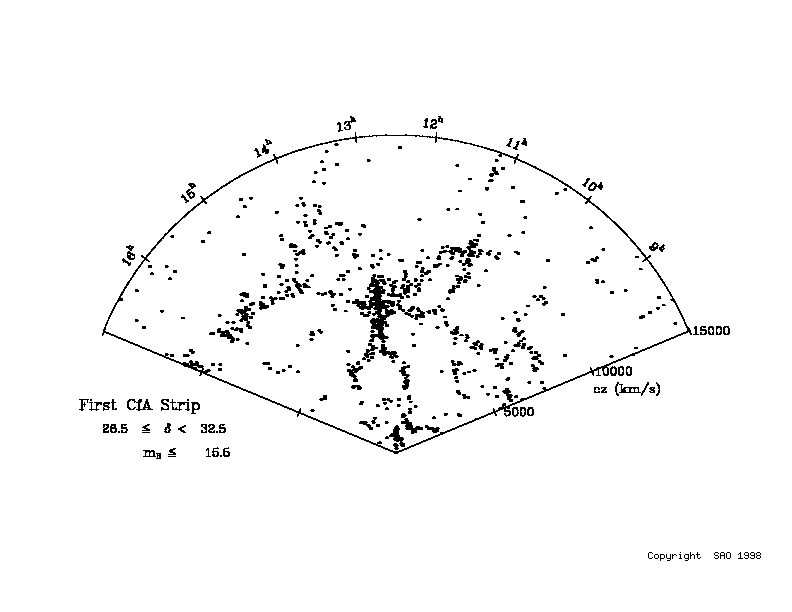
(image courtesy Smithsonian Astronomical Observatory, Geller and Huchra et al)
With more 'slices' of galaxies, it looked like this: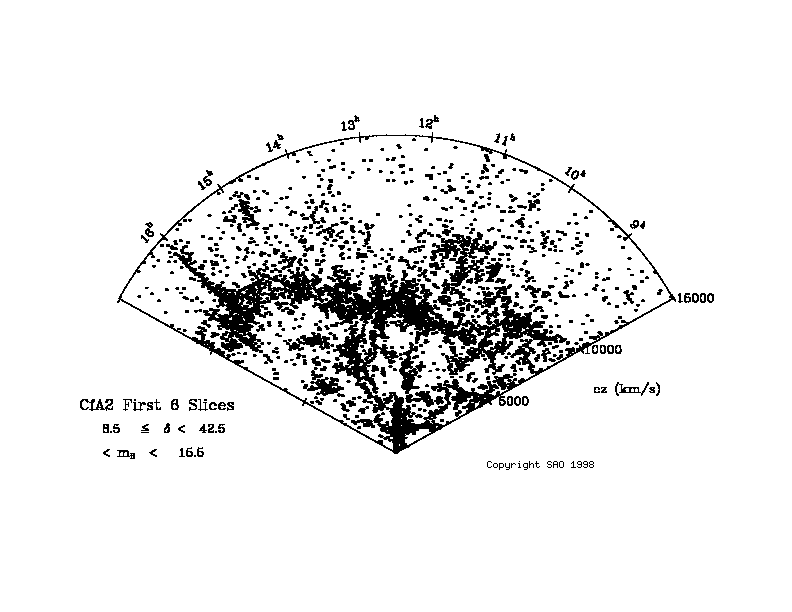
That huge structure across the middle of the figure? That's the Great Wall, a megastructure about 200 million light years away. It measures some 600 by 250 by 30 megalightyears. It is probably the single largest concentration of mass ever detected. One hell of a legacy.
Huchra also is the namesake of Huchra's Lens, the galaxy that causes the gravitational lensing that produces the famous Einstein's Cross:

Huchra was also well regarded in astronomy circles for being a very interesting and amusing man. Phil Plait and Sean Carroll have more eloquent remarks than I.
Mr. Huchra, you will be missed.
He was one of the major forces behind the famed CfA study. The CfA Redshift Survey was started in 1977 to do nothing less than map the universe. The idea is simple: Take the redshift of thousands of galaxies - velocity measurements which correspond to distance - and plot them on one big chart.
The results were surprising. Instead of random distribution of galaxy clusters, the clusters were themselves organized into huge filaments and bubbles measuring billions of light years across. This resulted in the famous stickman image:
(image courtesy Smithsonian Astronomical Observatory, Geller and Huchra et al)
With more 'slices' of galaxies, it looked like this:
That huge structure across the middle of the figure? That's the Great Wall, a megastructure about 200 million light years away. It measures some 600 by 250 by 30 megalightyears. It is probably the single largest concentration of mass ever detected. One hell of a legacy.
Huchra also is the namesake of Huchra's Lens, the galaxy that causes the gravitational lensing that produces the famous Einstein's Cross:
Huchra was also well regarded in astronomy circles for being a very interesting and amusing man. Phil Plait and Sean Carroll have more eloquent remarks than I.
Mr. Huchra, you will be missed.
Tuesday, September 28, 2010
Project A119: The Flash
So, then. This project A119. Just how bright would the flash have been?
Fortunately, we have a pretty nifty benchmark. On August 11, 2004, astronomers observed the first known Perseid impact on the moon. What was calculated to be a 12g impactor hit the moon at 61,000 meters per second (approximately 137,000 mph), creating a flash lasting 1/30th of a second. Its visual magnitude was 9.5.
Each visual magnitude is 2.5* times fainter than a magnitude lower, and lower numbers are brighter. Thus, Jupiter at -4 is 100 times brighter than a magnitude 1 star.
E= 1/2 * mass * velocity2, so E = 1/2*12g*(61000m/s)2 = 22 Megajoules. (=2.2 * 107 J)
The largest US nuclear test was the Castle Bravo test of 1954, with a yield of 15 Megatons of TNT, which equals 63 petajoules (= 6.3 * 1016 J).
Assuming the energy / light ratio is similar, we can calculate just how bright the flash would have been.
6.3E16** / 2.2E7 = 2.9E9 times brighter. That's 2.9 BILLION*** times brighter.
log2.52.9E9 = 23.8 magnitudes brighter than 9.5. 9.5 - 23.8 = magnitude -14.3.
The full moon, by comparison, is magnitude -12.7. The nuke would be 4.3 times brighter than the full moon.
* actually the fifth root of 100, 2.512, so that 5 magnitudes is equal to 100 times difference in brightness
** Exponential notation. 1.5E4 = 1.5*104 = 1.5*10000 = 15000
*** American billion - 109
Fortunately, we have a pretty nifty benchmark. On August 11, 2004, astronomers observed the first known Perseid impact on the moon. What was calculated to be a 12g impactor hit the moon at 61,000 meters per second (approximately 137,000 mph), creating a flash lasting 1/30th of a second. Its visual magnitude was 9.5.
Each visual magnitude is 2.5* times fainter than a magnitude lower, and lower numbers are brighter. Thus, Jupiter at -4 is 100 times brighter than a magnitude 1 star.
E= 1/2 * mass * velocity2, so E = 1/2*12g*(61000m/s)2 = 22 Megajoules. (=2.2 * 107 J)
The largest US nuclear test was the Castle Bravo test of 1954, with a yield of 15 Megatons of TNT, which equals 63 petajoules (= 6.3 * 1016 J).
Assuming the energy / light ratio is similar, we can calculate just how bright the flash would have been.
6.3E16** / 2.2E7 = 2.9E9 times brighter. That's 2.9 BILLION*** times brighter.
log2.52.9E9 = 23.8 magnitudes brighter than 9.5. 9.5 - 23.8 = magnitude -14.3.
The full moon, by comparison, is magnitude -12.7. The nuke would be 4.3 times brighter than the full moon.
* actually the fifth root of 100, 2.512, so that 5 magnitudes is equal to 100 times difference in brightness
** Exponential notation. 1.5E4 = 1.5*104 = 1.5*10000 = 15000
*** American billion - 109
Project A119
So, back in the 1950s, it was the height of the cold war. The US and the Soviet Union were engaged in the sort of contest that usually involves a small change of painful zipper mishaps. The Space Race was just heating up, and everyone was thinking big. So, the newly-formed NASA formulated a plan to land men on the moon... and the Air Force formulated a plan to nuke it.
I only wish I was kidding. Project A119, guys and ladies.
I only wish I was kidding. Project A119, guys and ladies.
Monday, September 13, 2010
Heavy Mithril
For some reason, it seems that being a nerd can help you play epic music. TVTropes calls it Heavy Mithril.
For example:
Ozzy yells about wizards:
"Evil power disappears / Demons worry when the wizard is near"
And yells about spaceships and fleeing an apocalyptic Earth:
"Rocket engines burning fuel so fast / Up into the night sky they blast"
Led Zeppelin, meanwhile, has been reading their Tolkien:
"Twas in the darkest depths of Mordor, I met a girl so fair
But Gollum, and the Evil One, crept up and stole away with her"
But, for the ultimate nerdy songs, how about having an astrophysicist playing guitar. Queen does in Brian May. In '39, they sing about RELATIVISTIC TIME DILATION:
"For so many years have gone/though I'm older but a year"
For example:
Ozzy yells about wizards:
"Evil power disappears / Demons worry when the wizard is near"
And yells about spaceships and fleeing an apocalyptic Earth:
"Rocket engines burning fuel so fast / Up into the night sky they blast"
Led Zeppelin, meanwhile, has been reading their Tolkien:
"Twas in the darkest depths of Mordor, I met a girl so fair
But Gollum, and the Evil One, crept up and stole away with her"
But, for the ultimate nerdy songs, how about having an astrophysicist playing guitar. Queen does in Brian May. In '39, they sing about RELATIVISTIC TIME DILATION:
"For so many years have gone/though I'm older but a year"
Wednesday, September 1, 2010
Here we go again...
Another year of school has started. Same morons blocking the hall, same unidentifiable cafeteria food, same everything. I really hope this changes in college, because even with great classes and teachers, I'm going to go insane. If the Catholic Church is looking for a suitable location for Purgatory, I suggest they check out their local public high school.
My schedule for this semester is as follows (blocks are 82 minutes each; | separates alternating classes):
Block 1: Advanced Placement Physics B
Block 2: UConn ECE Marine Science (similar in scope to AP, though not as difficult)
Block 3: Symphonic Band | Study
Block 4: Study | Study
Looks pretty easy, no? Well... On Tuesdays and Thursdays, separate from my high school's schedule, I'm taking Multivariable Calculus at Conn College. It's a 200-level course. It's going to be awesome.
I really like this. Three awesome math and science courses. 3 out of every 10 days, I can leave after two classes and be home by 11:15. 3 out of 10, I can still be home by 1:00.
But, 4 days out of ten, I have to brave Interstate 95 and rush to my course at Conn. It's gonna be great, but that course is going to kick my ass and then break my back with homework. It starts tomorrow. Here goes nothing...
My schedule for this semester is as follows (blocks are 82 minutes each; | separates alternating classes):
Block 1: Advanced Placement Physics B
Block 2: UConn ECE Marine Science (similar in scope to AP, though not as difficult)
Block 3: Symphonic Band | Study
Block 4: Study | Study
Looks pretty easy, no? Well... On Tuesdays and Thursdays, separate from my high school's schedule, I'm taking Multivariable Calculus at Conn College. It's a 200-level course. It's going to be awesome.
I really like this. Three awesome math and science courses. 3 out of every 10 days, I can leave after two classes and be home by 11:15. 3 out of 10, I can still be home by 1:00.
But, 4 days out of ten, I have to brave Interstate 95 and rush to my course at Conn. It's gonna be great, but that course is going to kick my ass and then break my back with homework. It starts tomorrow. Here goes nothing...
Wednesday, August 4, 2010
Possible Aurora Tonight!
On Sunday, astronomers at the Harvard-Smithsonian Center for Astrophysics, using images from the SDO, discovered 4 large Coronal Mass Ejections on the surface of the sun. By pure chance, they're aimed directly at earth. Between this morning and tonight, we're getting blasted with streams of high-energy particles moving at 1.2 million miles per hour.
Not to worry. The Earth's thick atmosphere and powerful magnetosphere will prevent any dangerous radiation from hitting us. In fact, most of the radiation will be low-energy photons, with wavelengths between 450 and 650 nanometers. Conveniently, visible light.
In other words, we're getting an aurora tonight. The first two were at 0700 and 1700 UTC (Greenwich Mean Time) today; the next are at 0000 and 0600 UTC tomorrow morning. For those of you on the US east coast, that's 800 tonight and 200 tomorrow morning. It'll be visible down below 45° N.
And it's gonna be cloudly tonight. Bugger.
Not to worry. The Earth's thick atmosphere and powerful magnetosphere will prevent any dangerous radiation from hitting us. In fact, most of the radiation will be low-energy photons, with wavelengths between 450 and 650 nanometers. Conveniently, visible light.
In other words, we're getting an aurora tonight. The first two were at 0700 and 1700 UTC (Greenwich Mean Time) today; the next are at 0000 and 0600 UTC tomorrow morning. For those of you on the US east coast, that's 800 tonight and 200 tomorrow morning. It'll be visible down below 45° N.
And it's gonna be cloudly tonight. Bugger.
Friday, July 23, 2010
Radioactive Steel
A interesting side note about nuclear testing: all steel made since 1945 is contaminated. For millenia to come. Radioactive iron and carbon isotopes from atmospheric detonations have introduced a very small amount of radioactivity to all steel produced. It's not a harmful amount. Not even close. It's been decades sonce there were atmospheric tests. It's not even detectable by most detectors. But, it's enough that certain sensitive detectors, particularly Geiger counters, cannot be made of radioactive steel.
Usually aluminium* can be used, but if it's not, then there's only one thing to do. Pre-1945 steel must be found that has not been exposed to air that carries radioisotopes. There's not a lot of it around.
Fortunately, water is one of the best moderators known. A few feet will stop a lot of radiation, and prevent the radioisotopes in the air from reaching any steel.
Now, no one had the bright idea to stockpile a bunch of steel underwater before the first atmospheric test, but we do have the next best thing. Shipwrecks. Thousands of tons of pre-radiation steel, underwater. Unfortunately, most shipwrecks are in inconveniently deep water. The deep waters of the Atlantic and Pacific, from WWI and WWII shipping and warships.
There is one source of convenient steel, though. In June 1919, Admiral Von Reuter ordered his German fleet scuttled under the noses of their British captors to spite them. When it was over, the scuttling of the fleet left 52 ships on the seafloor of Scapa Flow, a Scottish bay. 45 of them were later raised, but 3 battleships and 4 cruisers remain. Small piece are retrieved occasionally by divers for use in instruments.
Usually aluminium* can be used, but if it's not, then there's only one thing to do. Pre-1945 steel must be found that has not been exposed to air that carries radioisotopes. There's not a lot of it around.
Fortunately, water is one of the best moderators known. A few feet will stop a lot of radiation, and prevent the radioisotopes in the air from reaching any steel.
Now, no one had the bright idea to stockpile a bunch of steel underwater before the first atmospheric test, but we do have the next best thing. Shipwrecks. Thousands of tons of pre-radiation steel, underwater. Unfortunately, most shipwrecks are in inconveniently deep water. The deep waters of the Atlantic and Pacific, from WWI and WWII shipping and warships.
There is one source of convenient steel, though. In June 1919, Admiral Von Reuter ordered his German fleet scuttled under the noses of their British captors to spite them. When it was over, the scuttling of the fleet left 52 ships on the seafloor of Scapa Flow, a Scottish bay. 45 of them were later raised, but 3 battleships and 4 cruisers remain. Small piece are retrieved occasionally by divers for use in instruments.
What the Hell were We Thinking?
I'm almost finished reading a very interesting book about US nuclear weapons design and testing. Much of the information is only recently declassified. It's absolutely fascinating stuff. And profoundly depressing, just how willing humanity was to come to the brink of apocalypse and stare into the abyss.
A Japanese artist, Isao Hashimoto, made a flash animation of every nuclear detonation between 1945 (the Trinity tests, Hiroshima, and Nagasaki) and 1998 (India and Pakistan). It's very sobering, watching over 2000 blips on that screen. Each one wquivalent to between 100 and 50,000,000 TONS of trinitrotolulene (TNT). It's well worth the 13 minutes to watch. It starts out slow, but around 3:30 in it gets crazy.
The only possible detonations not shown are the 2006 and 2009 North Korean tests and the Vela Incident, a possible Israeli test in 1979.
A Japanese artist, Isao Hashimoto, made a flash animation of every nuclear detonation between 1945 (the Trinity tests, Hiroshima, and Nagasaki) and 1998 (India and Pakistan). It's very sobering, watching over 2000 blips on that screen. Each one wquivalent to between 100 and 50,000,000 TONS of trinitrotolulene (TNT). It's well worth the 13 minutes to watch. It starts out slow, but around 3:30 in it gets crazy.
The only possible detonations not shown are the 2006 and 2009 North Korean tests and the Vela Incident, a possible Israeli test in 1979.
Sunday, June 13, 2010
Another one of those geeky moments
Been a while since the last one that I wrote about. Yesterday, I managed to identify a train from 2 miles away by nothing but sound.
So, I was out golfing. In the rain, which is not a lot of fun, but I had some good shots. The golf course is only about three miles from the train tracks, so I could hear trains when the rain was light.
At one point, I heard a train whistle to the southwest, then later to the southeast. The pitch shifted a bit between them, so I guessed, based on the Doppler effect, that the train had to be moving at a pretty decent clip.
Now, there's only two services that operate on that section of the Northeast Corridor. There's the Northeast Regional, the local service. However, it stops at Mystic and Westerly, just nine miles apart, and it's only two miles from the Mystic station. Therefore, it would not be at full speed when passing the course.
I, then made a guess that this train, which I could not see, was the only other service along that section of the NEC, the Acela Express, the high-speed service. What a geek I am.
I was, of course correct.
My reasoning was as follows: On weekends, no Acelas stop at nearby New London Union Station, so they have a straight-shot run at better than 110 mph from New Haven to Providence. This train, going northbound, left New Haven at 131 pm and did not stop until 307 at Providence. It was likely going around 120 mph when passing by, accounting for the pronounced Doppler effect.
So, I was out golfing. In the rain, which is not a lot of fun, but I had some good shots. The golf course is only about three miles from the train tracks, so I could hear trains when the rain was light.
At one point, I heard a train whistle to the southwest, then later to the southeast. The pitch shifted a bit between them, so I guessed, based on the Doppler effect, that the train had to be moving at a pretty decent clip.
Now, there's only two services that operate on that section of the Northeast Corridor. There's the Northeast Regional, the local service. However, it stops at Mystic and Westerly, just nine miles apart, and it's only two miles from the Mystic station. Therefore, it would not be at full speed when passing the course.
I, then made a guess that this train, which I could not see, was the only other service along that section of the NEC, the Acela Express, the high-speed service. What a geek I am.
I was, of course correct.
My reasoning was as follows: On weekends, no Acelas stop at nearby New London Union Station, so they have a straight-shot run at better than 110 mph from New Haven to Providence. This train, going northbound, left New Haven at 131 pm and did not stop until 307 at Providence. It was likely going around 120 mph when passing by, accounting for the pronounced Doppler effect.
Friday, March 12, 2010
Birthday
Today's my birthday! I got a new beta fish, a bag of gummy bears, and this awesome t-shirt:

It's a real neat equation, combining physics, math, and chemistry. E=mc2, so the first third of the equation is M. The square root of -1 is the imaginary unit, or I. The ideal gas law gives PV=nRT, so the third section is T.
M. I. T.
MIT.
It's a real neat equation, combining physics, math, and chemistry. E=mc2, so the first third of the equation is M. The square root of -1 is the imaginary unit, or I. The ideal gas law gives PV=nRT, so the third section is T.
M. I. T.
MIT.
Sunday, February 7, 2010
History Day!
It's been over a year since I did a proper History Day post. Which means it's time for the tradition to start again...
1804: John Deere - yes, *that* John Deere - was born.
1812: The strongest (Magnitude 8.3) of the New Madrid earthquakes destroyed the town of New Madrid, toppled buildings in St. Louis, made waterfalls on the Mississippi and changed it course, caused a wave to run UPSTREAM on the Mississippi, and rang church bells all the way to Boston.
Also 1812: Charles Dickens, great and intolerably boring Victorian writer, was born.
1867: Pinoneering pioneer writer Laura Ingalls Wilder was born.
1889: Harry Nyquist, a founding informational theorist, was born.
1906: Oleg Antonov, Soviet aerospace engineer, designer of planes from small biplanes to the monster An-225, and the founder of the eponymous Antonov design firm; was born.
1926: Konstantin Feoktistov, cosmonaut and spacecraft designer, was born.
1932: Apollo 15 command module pilot Al Worden was born.
1935: Monopoly is invented. Rainy Sunday afternoons become a little less boring.
1959: Baseballer extraordinaire Nap Lajoie died at 84.
1960: Igor Kurchatov, father of the Soviet atomic bomb but also an advocate of peaceful nuclear power, died at 57.
1979: For the first time since Pluto's 1930 discovery, its orbit brought it closer to the sun than Neptune.
1984: On the Shuttle mission STS-41B, astronauts Bruce McCandless and Robert L. Stewart performed the first untethered spacewalks using the MMU.
1990: The Soviet Union ended when the Central Committee of the Soviet Communist Party relinquished its power.
1999: King Hussein of Jordan, a skilled diplomat, peacemaker, democratic and civil rights activist, ameteur radio operator, pilot, and all-around awesome guy; died at age 63 after having ruled Jordan since age 17.
2010: A large explosion at a power plant in Middletown, CT - near where I live - killed at least 5 workers.
All information except the last item from Wikipedia.
1804: John Deere - yes, *that* John Deere - was born.
1812: The strongest (Magnitude 8.3) of the New Madrid earthquakes destroyed the town of New Madrid, toppled buildings in St. Louis, made waterfalls on the Mississippi and changed it course, caused a wave to run UPSTREAM on the Mississippi, and rang church bells all the way to Boston.
Also 1812: Charles Dickens, great and intolerably boring Victorian writer, was born.
1867: Pinoneering pioneer writer Laura Ingalls Wilder was born.
1889: Harry Nyquist, a founding informational theorist, was born.
1906: Oleg Antonov, Soviet aerospace engineer, designer of planes from small biplanes to the monster An-225, and the founder of the eponymous Antonov design firm; was born.
1926: Konstantin Feoktistov, cosmonaut and spacecraft designer, was born.
1932: Apollo 15 command module pilot Al Worden was born.
1935: Monopoly is invented. Rainy Sunday afternoons become a little less boring.
1959: Baseballer extraordinaire Nap Lajoie died at 84.
1960: Igor Kurchatov, father of the Soviet atomic bomb but also an advocate of peaceful nuclear power, died at 57.
1979: For the first time since Pluto's 1930 discovery, its orbit brought it closer to the sun than Neptune.
1984: On the Shuttle mission STS-41B, astronauts Bruce McCandless and Robert L. Stewart performed the first untethered spacewalks using the MMU.
1990: The Soviet Union ended when the Central Committee of the Soviet Communist Party relinquished its power.
1999: King Hussein of Jordan, a skilled diplomat, peacemaker, democratic and civil rights activist, ameteur radio operator, pilot, and all-around awesome guy; died at age 63 after having ruled Jordan since age 17.
2010: A large explosion at a power plant in Middletown, CT - near where I live - killed at least 5 workers.
All information except the last item from Wikipedia.
Subscribe to:
Posts (Atom)


